
◦ Why we do this · Kotivara
72 hours is the recommendation. I'm testing a month.
There's a Finnish word, kotivara. It means the food and supplies you keep at home out of ordinary habit — not for a crisis, just because that's what you do.
My grandparents had a cellar with months in it. Potatoes, root vegetables, salted fish, jars of berries, a woodshed stacked two winters deep. Nobody called them preppers. They'd have found the word hilarious.
I checked my own kitchen before we moved out here. Three days. I did have a genuinely impressive amount of coffee, which I'm told doesn't count.
Why I actually left
People assume I left because I wanted to stop working. I do roughly the same amount of work as I did as a CEO — those days ran twelve to sixteen hours easily, and the hours out here aren't much kinder. This version is harder, colder, and occasionally involves a chainsaw I don't entirely trust.
The difference is that it stopped feeling like work. Some days I'm not sure it qualifies. It leaves me tired in the way that sleep actually fixes.
So let me be honest about it: I didn't get out of the wheel. I built a new one — and this time I write the rules.
That's the whole thing. In the old wheel I ran hard and somebody else decided what the running was for. What counted as a good year. What the numbers had to be. When it was enough. I was good at it for twenty years. I just never once chose the rules I was being measured against.
Here I chose them. The meter is a rule I wrote. Six months of winter is a target nobody handed me. If it takes three years, nobody is disappointed but me — and I'm allowed to change my mind about the whole thing in March.
That isn't freedom from work. It's freedom from someone else's definition of enough. It's a smaller claim than "I escaped the rat race," and it's the true one.
And it's why the number at the top of this page is the shape it is. Three days is a sensible recommendation someone else calculated. A month is mine.
If you're reading this at a desk: you probably don't want to stop working either. You want to know who's holding the pen.
My grandparents weren't being careful. They were being normal.
They were born into a country that had a civil war, fought two wars, resettled more than 400,000 people from Karelia, paid reparations for years, and lived under food rationing that didn't fully end until the 1950s.
Nobody who lived through that needed convincing that the world can change. The cellar wasn't fear. It was the ordinary conclusion of a long life — and, I suspect, a quiet satisfaction at having it.
I've had none of that. My whole adult life, the shelves have been full.
What changed isn't the danger — it's my exposure
I want to be careful here, because it would be easy to say "the modern world is fragile," sound wise, and be wrong.
By most measures this system is far better than the one my grandparents had. Nobody in Finland is rationing flour. Food arrives, in winter, to a village of sixty people, at a price they'd have refused to believe. That's remarkable and I'm not going to pretend otherwise.
But two things did change, and I spent a career on both sides of them.
Efficiency and buffer are opposites. Modern supply chains run just-in-time on purpose. Stock costs money, so it was engineered out — of factories, of warehouses, of shops, and eventually out of houses. I did this personally. I ran companies that treated inventory as waste. It's completely correct, right up until the chain hiccups.
And the failures moved. My grandparents' bad years were slow and local: a poor harvest, an early frost, something you could watch coming across a season. Today's version is fast and far away — a ship wedged in a canal, a chip plant on another continent. You find out on a Thursday, at the shop.
So no, the world isn't more dangerous than it was in 1943. That would be a ridiculous thing to say, and my grandparents would have laughed me out of the room.
My claim is much smaller: they had months in the cellar and a system that failed slowly. I had three days.
Finland already has a number
There's a national preparedness recommendation here called 72 tuntia — 72 hours. It's coordinated by the Finnish National Rescue Association and funded by the National Emergency Supply Agency, and it says every household should be able to carry on independently for three days. Its foundation is kotivara: food, water, medicine, and knowing what to do.
Three days is the official floor, and it exists because someone sat down and did the arithmetic. I'm not arguing with it.
I'm just curious about a different number, and it's mine to pick.
The ten-year list
I didn't arrive here through a feeling. I arrived through a list. I know how a table like this reads, so I'll say it first: I don't find it frightening. I find it interesting, which is a different thing, and it's why I started counting.
| Year | Event | Effect |
|---|---|---|
| 2017 | Hurricanes Harvey, Irma, Maria | Refining, chemicals, pharmaceuticals and logistics disrupted |
| 2018–2019 | US–China trade tariffs | Costs rose; production began moving out of China |
| 2020–2022 | COVID-19 | Port congestion, container shortage, factory closures, freight costs up several times over |
| 2021 | Suez Canal blockage | Around 12% of world seaborne trade delayed for weeks |
| 2021–2023 | Semiconductor shortage | Stoppages across automotive, electronics and machinery |
| 2022– | Russia's invasion of Ukraine | Grain, fertiliser, energy, metals and timber availability fell |
| 2022 | European energy crisis | Electricity and gas prices rose sharply |
| 2023– | Red Sea disruption | Trade rerouted around Africa; transit 1–3 weeks longer |
| 2024– | Extreme weather | Drought at the Panama Canal; floods and fires hit transport and farming |
| 2026– | Iran war and the closure of the Strait of Hormuz | The IEA calls it the largest supply disruption in the history of the global oil market; fuel and fertiliser costs rising now |
| Throughout | Cyberattacks | Ports, logistics firms and food producers hit by shutdowns |
On food specifically: fertiliser prices multiplied in 2022. Grain and vegetable oil exports from Ukraine were disrupted. Coffee, cocoa and olive oil rose after poor harvests.
On the shelf it looked mundane — yeast and flour missing in patches, building materials on long lead times, prices climbing through 2022 and 2023.
None of it was the end of anything. The system didn't break. It just stopped being quite so reliable, in small ways, fairly often, for a decade.
What that decade did to a trolley — and to an hour of work
Numbers at that scale are easy to nod at and hard to feel. So here's the version I actually think about, in the only unit that means anything to me.
When Finland switched to the euro at the start of 2002, the average full-time wage in this country was €2,287 a month. By late 2025 it was €4,180 — up about 83 per cent. That sounds like progress, and in some ways it is.
I bought a great deal of mince in those years. Three children, the pork-and-beef mix, the 400-gram pack, most weeks. I remember the price tag turning over at the changeover — about four markka became roughly 70 cents — and then climbing to a euro faster than almost anything else on the shelf.
That same pack today: the supermarket's own-brand 400 g pork-and-beef is €3.59. The better one is €4.25. If you want actual beef rather than the mix, you're at €6.29 for the shop's own label and €8.99 for a branded one.
So the wage went up 83 per cent. The pack went up several hundred.
Now put it in time, which is how I think. At 2002 wages that pack cost roughly three or four minutes of gross working time. Today the same pack costs about eight. Twice the work for the same dinner — and that's gross, before tax, so the real figures are longer at both ends.
Two caveats, and I'd rather say them myself than have them said to me. The 70 cents is my memory, not a statistic, and I'm checking it against Statistics Finland's own price series on camera. And if I compared my old pork-and-beef pack with today's proper beef mince, I'd be measuring my tastes improving rather than my money weakening. Like for like, it's still about double.
I don't think that's a positive development. I'm not going to dress it up as anything cleverer than that.
And it's also, I notice, the same instinct as the meter. The meter measures months. This measures minutes. I'm apparently a man who converts everything into a unit he can count, which my wife finds tiresome and I find calming.
What the corporations did about it
The part that actually persuaded me isn't the list. It's what the companies on the receiving end of that list did next, quietly, without a single press release about resilience.
They spread sourcing across more countries. They raised inventory. They moved production closer to their markets. They invested in security of supply.
Corporations are not sentimental and they don't panic. They hold buffer stock because the maths says a buffer is cheaper than a shortage. I spent twenty years making exactly that calculation for a living.
Then I went home to a kitchen with three days in it and never once made it for myself. That's not a warning about the world. That's just funny.
In case you were wondering: no bunker
I should say this plainly, because the subject attracts a certain tone I'd rather keep away from here.
I'm not preparing for collapse. There's no bunker, no radio room, no wall of tins with a spreadsheet beside it. I don't think you're foolish for having a job and a supermarket down the road — I had both for most of my life, and I'd still have them if I hadn't wanted to write my own rules.
What I'm doing is far more boring, and much more fun than it sounds.
So here's the rule I wrote
On the homestead we keep a meter. Six rows: carbohydrates and vegetables, protein, eggs, fat, berries and mushrooms, firewood. Each row is measured in one unit only — how many months of winter it covers.
Six months means self-sufficient. Three is the lower marker. Anything past that becomes something to trade with the neighbours, who are better at all of this than I am and are extremely aware of it.
Next to the meter sits a euro figure: €6,000 — roughly what six months of winter food costs two people in Finland, eating properly.
It is not a budget. Nobody handed me €6,000 and told me to make it last. It's the bill that turns up every year whether I like it or not, and it turned up every year for the twenty I spent earning well enough not to notice it.
So the actual question is narrower than it looks: can that bill be paid once — in work, seeds, birds and a cellar — instead of every year forever? That's the whole experiment. Not living cheaply for a winter. Converting a cost that repeats into one that doesn't.
Which is why self-sufficiency here has to mean repeatable. If we scrape through one winter and then start again from nothing next spring, we've proved nothing except that we can go hungry on purpose. If next winter we could buy nothing at all and still eat — and the winter after that — the number has done its job. If it ever goes further and the cellar produces more than two people need, the bill stops being a bill and starts being income. That's the version I'd like, and I'm not counting on it.
Plenty of people film self-sufficiency. Almost nobody puts the money beside it and admits when the number is bad. We do, every week, including the weeks it goes backwards. It goes backwards more than I'd like.
◦ The meter
Week 0 — the starting line
Starting from nothing: can two people reach repeatable food self-sufficiency in one year, for the €6,000 that six months of winter food would have cost them anyway — plus their own labour?
This is the meter itself, as it stood on 25 July 2026. Every row is measured in months of winter covered, and the headline number is the weakest row rather than an average — a cellar is only as good as the thing it runs out of first.
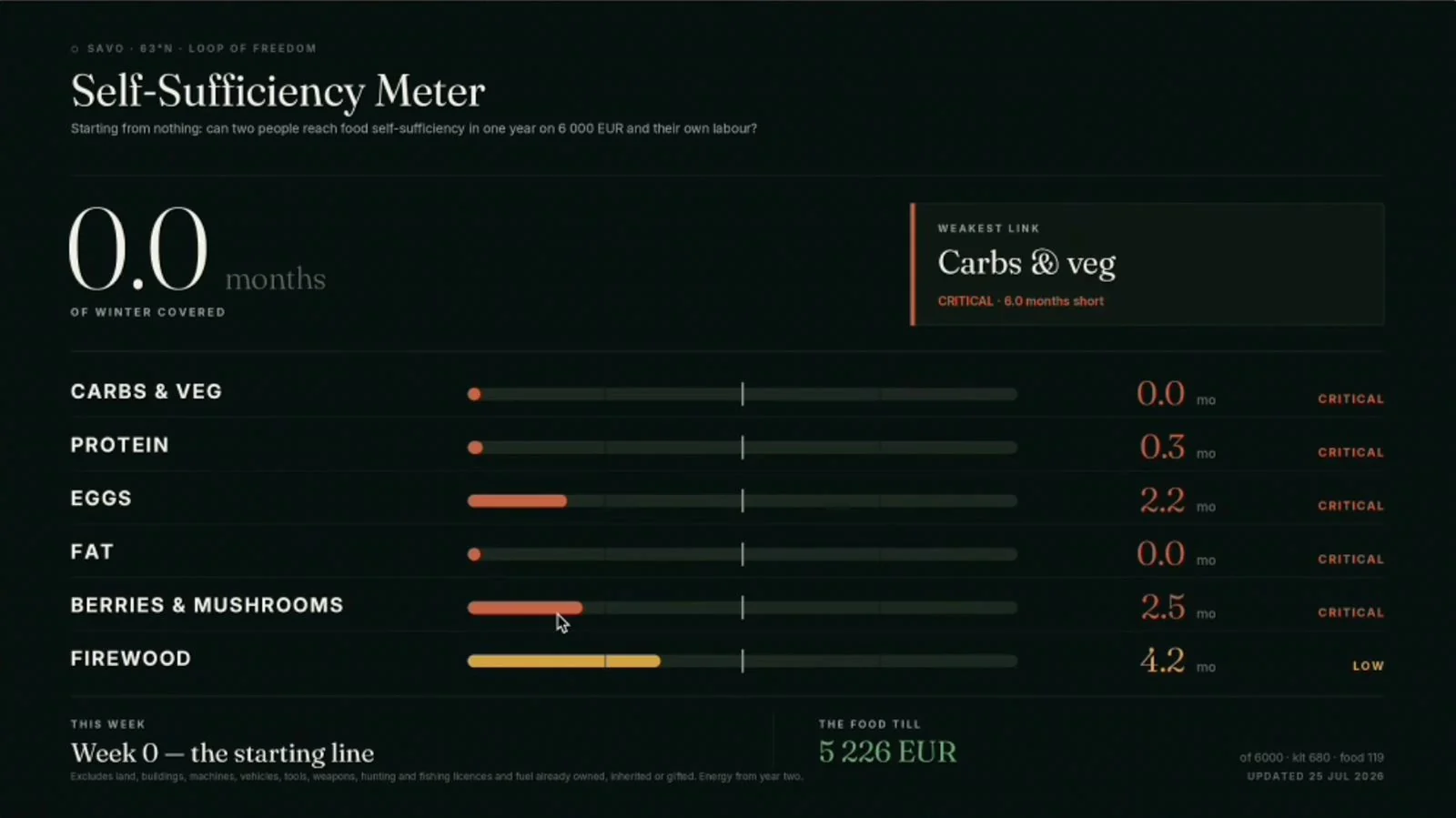
| Row | Months of winter covered | Status |
|---|---|---|
| Carbs & veg | 0.0 | Critical |
| Protein | 0.3 | Critical |
| Eggs | 2.2 | Critical |
| Fat | 0.0 | Critical |
| Berries & mushrooms | 2.5 | Critical |
| Firewood | 4.2 | Low |
| Overall — months of winter covered | 0.0 | Weakest link: Carbs & veg — 6.0 months short |
The food till: Spent so far: €680 on kit and €119 on food. Measured against the €6,000 that six months of winter groceries would have cost — not a budget to stay under, but the bill this is trying to replace.
Excludes land, buildings, machines, vehicles, tools, weapons, hunting and fishing licences, and fuel already owned, inherited or gifted. Energy from year two. · Reading taken 2026-07-25
Yes, you could beat €6,000 — and that's the point
You can get well under that figure. Fill the trolley with the cheapest processed food on the shelf and you'll manage it without much trouble.
But then we aren't comparing the same thing. What comes out of my cellar isn't the cheap version, so the cheap version isn't the honest thing to measure it against. €6,000 is food I'd actually want to eat.
And there's a second answer, which matters more. Beat the figure and you've beaten it once — the bill turns up again next winter, and every winter after. That's the difference between shopping well and not having to shop. One is a discount. The other is a different arrangement.
The interesting question is why the gap between those two trolleys is so wide, because farming costs don't explain it.
Finland's Competition and Consumer Authority has looked at how a shelf price splits. Before VAT, roughly 35 cents in the euro goes to the producer, 40 to processing, 25 to the retailer — so there aren't many middlemen, there are essentially three stages. But it's an average, and it hides a lot: for rye bread the producer's share has been reported at around three per cent.
And nobody holds the full picture. The contracts between producers, processors and chains are confidential. No authority or research institute has comprehensive data on how your euro divides up. Not a conspiracy — just commercially ordinary. It does mean anyone quoting you a precise figure, me included, is quoting an estimate.
Organic is where it gets odd. The chairman of the Finnish Organic Association has pointed out that an organic product can sell for triple the conventional price while the gap in what the farmer is paid is less than half that. The premium you pay doesn't arrive at the farm.
I'm not accusing anyone. Centralised buying and logistics is a sensible answer to Finnish geography, and I'd have built the same thing. My point is the one I'd have made in a board meeting: every stage has to be paid for, and you're the one paying.
Which is the same rules problem in a different coat. Somebody else decided what my food costs and what's in it. Out here, I decide.
Short version, no forest required: buy direct. Finland has REKO rings — local producer-to-consumer groups where you order and collect straight from the farm. Fewer stages, and the money lands where the food came from.
The part I didn't expect
All of the above is the argument. None of it is why I'm still here.
I came for the logic and stayed for something I hadn't budgeted for: it's better. Not more virtuous. Better.
Food you grew tastes like something. I thought that was a line people said. It isn't. There were so few potatoes in that first harvest that I carried the whole lot inside in one hand — and they were still the best thing I've ever tasted.
Winter stopped being weather on a phone screen and became something we'd prepared for. You can see it from the porch, and through the window. Walking past a full woodshed gives me a particular satisfaction I never once got from a quarterly report.
The cellar isn't full yet. Twenty years of work and I could rarely point at a result — I think that soon I'll be able to open a door and look at one. That isn't nothing.
Kristiina, who didn't spend years dreaming of this and came anyway, says it more plainly than I can: it's quieter here, and we're not tired in the same way. Our nerves aren't as tight.
I didn't do this because I was afraid. I did it to get hold of the pen — and only afterwards found out it's the freest I've ever felt. I say that as a man who has recently spent a considerable amount of time eating berries off a bush in the yard while studying the behavioural culture of chickens.
What I notice most is that I stop. I stand still and I'm actually there. I smell the air. I listen to what the forest is doing. Sometimes I just sit down and let out a breath and say out loud, "well, this is good," and that's the entire activity. No process, no pressure. The phone rings and I don't answer it, and I don't feel bad about that either.
The test: one month
This winter I'm doing something simple and slightly stupid: one month living only on food I produced, caught, foraged or grew myself.
The rules go public before it starts, because half the honesty is in the exceptions. I cannot make salt. I have looked into this properly; please don't write to me about seawater. Coffee, obviously not. Flour, not unless you grew the grain. Those gaps are the most interesting part — they show exactly where self-sufficiency stops and the shop begins.
Setting the rules is the part I'm looking forward to most, which tells you everything about why I'm out here.
I don't know if I'll finish it. I don't know what's actually left in the cellar in March. If it falls apart, that's the episode — that's roughly how this works here.
Kristiina is with me in spirit and does her share of the work that goes into getting food, purely because it's enjoyable. But she does wonder, out loud and often, why I'm manifesting scarcity. Which is also why she doesn't watch the videos I make.
I don't think I'm manifesting scarcity. I'm manifesting resilience — the kind that holds whatever happens. And I'm simply this sort of person: someone who thinks in numbers and wants to know what the number actually is.
Maybe that changes for Kristiina one day. Maybe it doesn't. That's part of this too.
Questions people ask
What does kotivara mean?
Kotivara is the Finnish word for the food, water and supplies a household keeps at home as a matter of ordinary habit rather than for an emergency. It is the foundation of Finland's national 72-hour preparedness recommendation, and it was normal practice in Finnish homes for generations.
What is Finland's 72-hour recommendation?
Finland has a national preparedness recommendation called 72 tuntia, coordinated by the Finnish National Rescue Association and funded by the National Emergency Supply Agency. It asks every household to be able to carry on independently for three days — food, water, medicine, and knowing what to do — because three days is roughly how long organising help is estimated to take.
How do you measure self-sufficiency?
At Loop of Freedom, self-sufficiency is measured in months of winter covered, not in percentages. Six rows are tracked: carbohydrates and vegetables, protein, eggs, fat, berries and mushrooms, and firewood. Six months of coverage counts as self-sufficient; three months is the lower marker; anything beyond becomes barter with neighbours.
What is the €6,000 figure?
€6,000 is roughly what six months of winter food costs two people in Finland, eating properly — local, decent, not heavily processed. It is not a budget set aside for the experiment; it is the recurring annual bill the homestead is trying to replace. The test is whether that bill can be paid once, in labour and infrastructure, rather than every year indefinitely. Self-sufficiency at Loop of Freedom therefore means repeatable: if the following winter could be covered without buying food at all, the €6,000 has done its job.
Is this prepping, or preparation for collapse?
No. There is no bunker, no stockpile room and no collapse thesis. The framing is Finnish kotivara — ordinary household preparedness, plus a personal interest in knowing exactly what a beginner can produce and what it costs.
Has food really got more expensive relative to wages in Finland?
The average full-time monthly wage in Finland was €2,287 at the euro changeover in 2002 and €4,180 in late 2025, a rise of about 83 per cent. A 400-gram supermarket own-brand pork-and-beef mince pack now costs €3.59. Converted into working time, that pack costs roughly twice as many minutes of gross work as it did in 2002.
Come along
The weekly film follows the meter. Every week it moves, or it doesn't, and we say which.
If you'd rather not leave finding us to an algorithm, the letter comes by email: what moved, what it cost, what broke. Usually something broke.
◦ Watch
The meter, explained
Why it is measured in months, what each row has to hold, and what week zero actually looks like on the ground.
Two places to go next: the story of how we ended up on this homestead, or the places you can come and stay while we build it.
◦ Start here · Free
Start with the free Life Design Workbook
Get the workbook that helped me map my own way out of the rat race — the honest questions to ask yourself before you leap. It's free. Just tell me where to send it.